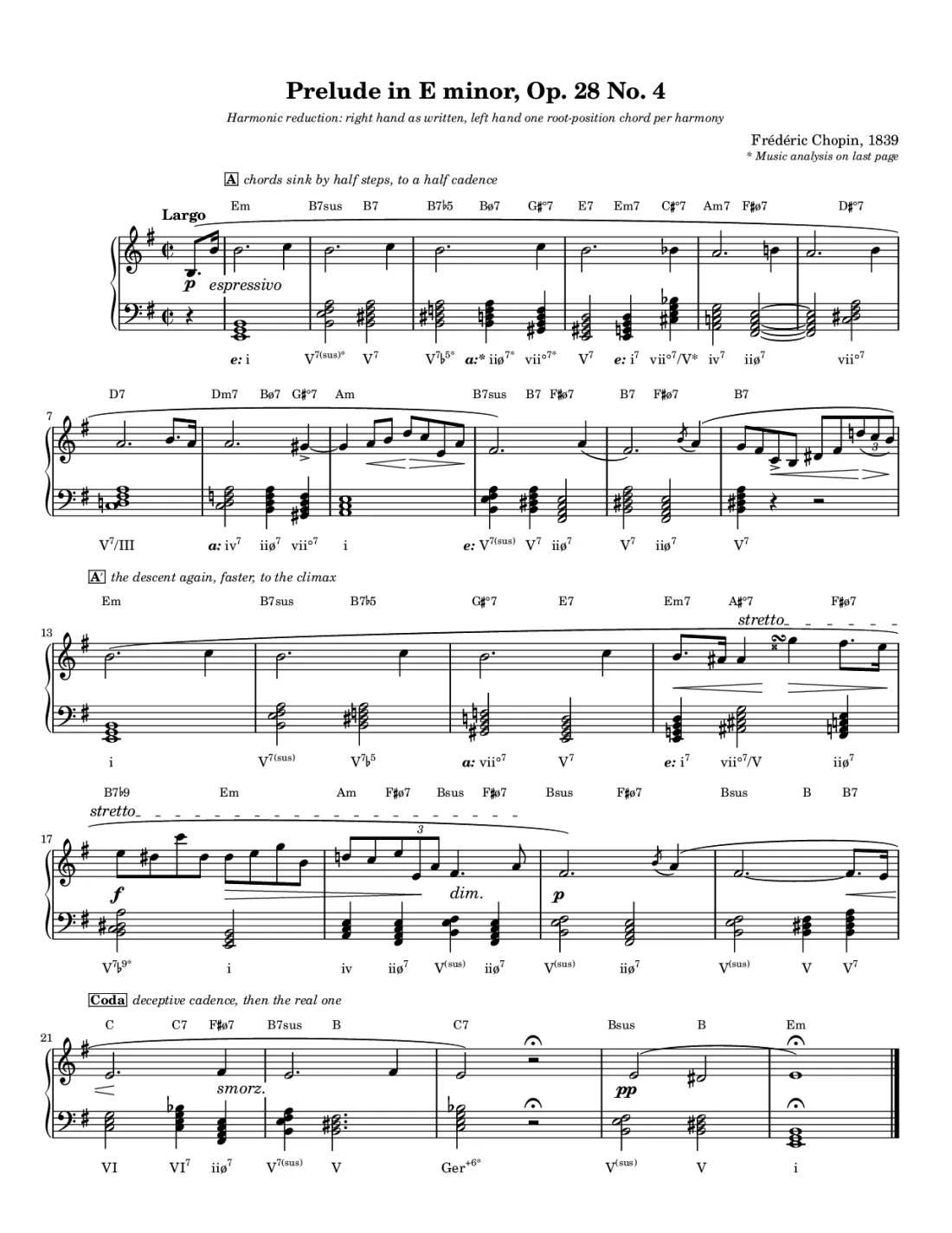
The left-hand chords sink by half steps, usually one note at a time, under a melody that barely moves.
25 bars2/2Largo2-page PDFLevel 3 of 8
Or every piece, now and later: Lifetime, $199
Form
A chords sink to a half cadenceA′ the descent again, fasterCoda deceptive cadence, then the real one
Opening, bars 1–4 · E minor
Section by section
A (1–12): the chords sink
Bars 3–4 lean toward A minor (numerals after a: count from A). Bars 5–8 hold A and C while the inner voices sink, reaching A minor in bar 9. Bars 10–12 stop on B⁷, a half cadence (a pause on V).
A′ (13–20): the descent again, faster
Bars 14–16 take the same road in half the time. Bar 17 is the climax: B⁷ with C on top (V⁷♭9), then E minor. Bar 20 stops on B⁷ again.
Coda (21–25): why the ending takes five bars
B⁷ does not go home: bar 21 lands on C major, a deceptive cadence. Bar 23 holds a German sixth (C, E, G, A♯, written B♭), then silence. Only then does B lead to E minor: V, i.
The PDF includes a full page of analysis.